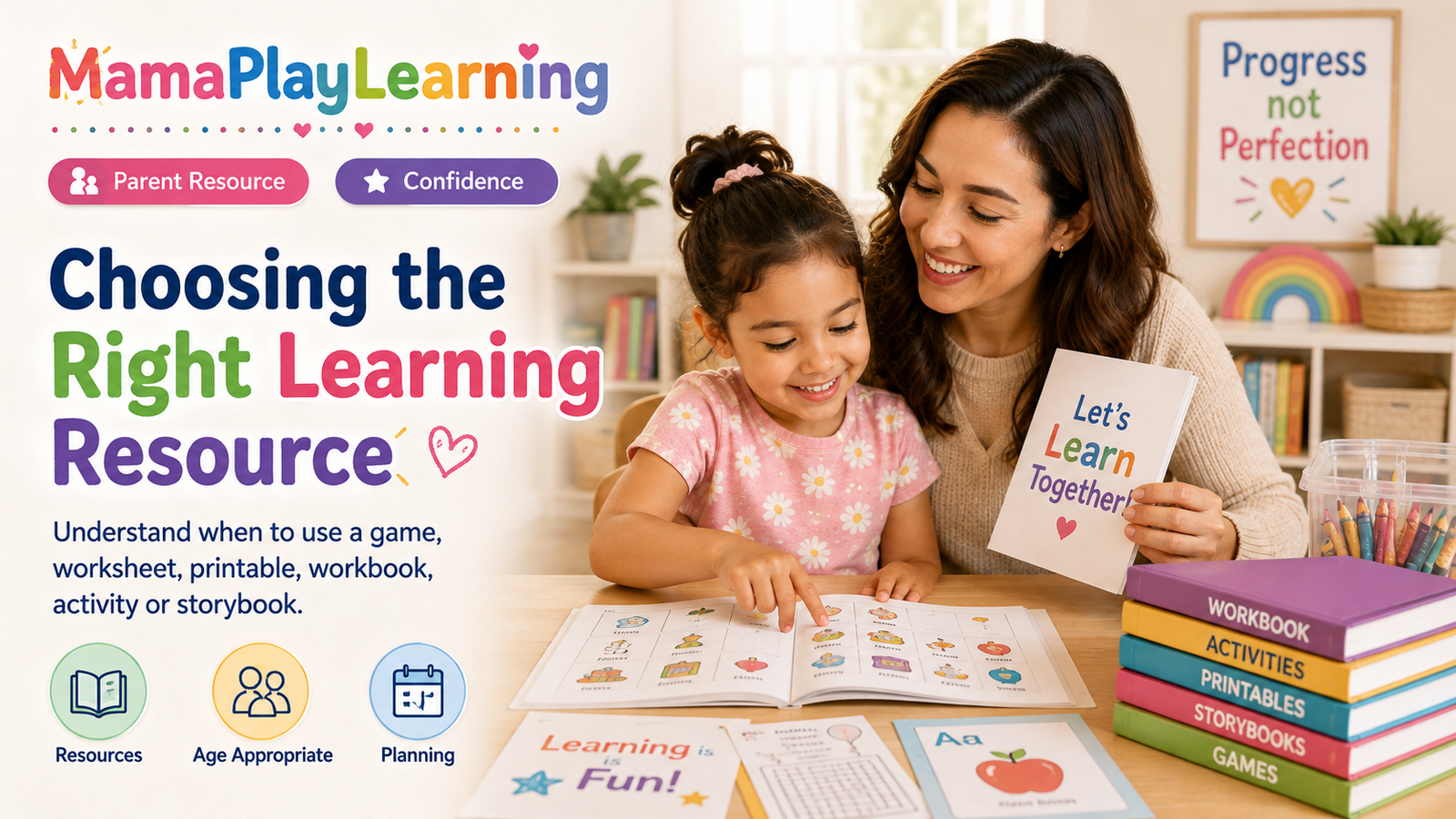
Choosing the Right Learning Resource
Understand when to use a game, worksheet, printable, workbook, activity or storybook.
There are more learning resources available to families than ever before. Parents and caregivers can choose from games, worksheets, printable activities, workbooks, storybooks, digital tools and hands-on materials.
Having many options can be helpful, but it can also feel overwhelming. A resource may look fun and educational without being the right match for the child, the skill or the moment.
The best learning resource is not always the biggest, newest or most expensive one. It is the one that fits what your child needs right now.
Start With the Skill You Want to Support
Before choosing a resource, identify the main goal.
You may want to support:
- Letter recognition
- Beginning sounds
- Counting and number sense
- Fine-motor control
- Vocabulary
- Problem-solving
- Confidence and persistence
One resource does not need to teach everything at once. A clear goal makes it easier to choose something simple and useful.
Consider the Child, Not Only the Age Label
Age recommendations can be useful, but they are only a starting point.
Children may develop skills at different rates. A child can be advanced in language while still needing more support with fine-motor skills. Another child may understand counting but need simpler directions and fewer distractions.
Consider:
- The child’s current ability
- Attention span
- Interests
- Frustration level
- Need for movement
- How much adult support is available
A resource is age-appropriate when the child can participate meaningfully without feeling bored or overwhelmed.
When to Use a Learning Game
Games are useful when children need repetition in a playful format.
A learning game may be a good choice for:
- Practicing letters or numbers
- Matching and memory
- Turn-taking
- Quick review
- Building motivation
Best for
Playful repetition, immediate feedback, participation and short practice sessions.
Games work best when the learning goal remains clear and the rewards do not become more important than the skill.
When to Use a Worksheet
A worksheet is usually best for short, focused practice.
It may be useful for:
- Tracing letters or numbers
- Matching pictures
- Identifying shapes
- Completing a simple pattern
- Practicing pencil control
Keep worksheet practice short
One useful page completed calmly can be more valuable than several pages finished through pressure or frustration.
Worksheets should support learning, not replace conversation, play and hands-on exploration.
When to Use a Printable
A printable can be more flexible than a standard worksheet.
Printables may include:
- Matching cards
- Sorting pieces
- Scavenger hunts
- Picture schedules
- Flash cards
- Cut-and-paste activities
Printables are especially useful when you want a low-cost resource that can be adapted for different ages or used in a hands-on way.
When to Use a Workbook
A workbook is helpful when skills build gradually over several pages or lessons.
It may be a good choice when:
- The child benefits from a familiar format
- The activities progress from easier to harder
- You want one organized place for practice
- The child will return to the same skill over time
A workbook does not have to be completed from front to back without breaks. Choose the pages that fit the child’s current needs.
When to Use a Hands-On Activity
Hands-on activities are useful when children need to experience a concept through movement, touch and exploration.
Examples include:
- Sorting objects
- Building with blocks
- Counting real items
- Creating art
- Exploring water or nature
- Acting out a story
Best for
Exploration, creativity, sensory learning, problem-solving and connecting ideas to real life.
Hands-on learning is especially valuable for young children because it allows them to test ideas rather than only look at them.
When to Use a Storybook
Storybooks support language, imagination, emotional understanding and connection.
A storybook may be the right resource when you want to:
- Introduce a new idea
- Build vocabulary
- Talk about feelings
- Encourage imagination
- Create a calm shared routine
Stories can also prepare children for later activities. A book about animals might lead into matching, drawing, movement or outdoor observation.
Compare the Different Resource Types
Game
Best for playful practice, motivation and repetition.
Worksheet
Best for short, focused skill practice.
Printable
Best for flexible, reusable and hands-on activities.
Workbook
Best for gradual progress and organized practice over time.
Hands-On Activity
Best for movement, exploration and real-world learning.
Storybook
Best for language, imagination, emotions and connection.
Match the Resource to the Child’s Energy
The right resource can change depending on the time of day.
A child with high energy may need a movement activity before sitting with a worksheet. A tired child may benefit more from a story than from a structured task.
Consider whether the child needs:
- Movement
- Quiet focus
- Adult connection
- Independent practice
- A familiar activity
- A new challenge
Look for Clear Directions and Simple Design
A resource can contain valuable content and still be difficult to use if the page or screen is crowded and confusing.
Look for:
- Clear instructions
- Readable text
- Age-appropriate images
- One main task at a time
- Enough space for the child to respond
- Limited visual distractions
A clean, understandable design helps the child focus on the learning goal.
Watch the Child’s Response
Engagement is one of the best signs that a resource fits.
A good match often looks like:
- Curiosity
- Participation
- Willingness to try again
- Comfortable challenge
- Interest in returning later
A poor match may lead to immediate frustration, confusion, boredom or constant adult correction.
Use More Than One Type of Resource
Resources can work together.
For example, you might:
- Read a story about shapes.
- Play a shape-matching game.
- Find shapes around the house.
- Complete one short printable.
This gives the child several ways to experience the same idea without repeating the exact same task.
Do Not Buy More Than You Can Realistically Use
It is easy to collect learning materials faster than a family can use them.
Before buying something new, ask:
- Do we already own something similar?
- Will this resource be used more than once?
- Does it support a skill we are actually working on?
- Can it grow with the child?
- Do we have space to store it?
A smaller collection of useful, familiar resources is often better than a large collection that feels overwhelming.
Helpful Learning Materials
The following optional materials can support several different kinds of early learning. Replace the links below with your own affiliate links or remove any recommendation you do not want to include.
Optional Resource Recommendations
Reusable Dry-Erase Sleeves
Turn favorite worksheets and printables into reusable practice pages.
View Dry-Erase SleevesLearning Card Organizer
Keep matching cards, flash cards and printable pieces sorted and easy to reach.
View OrganizersAge-Appropriate Workbook
A gradual workbook can provide organized practice for one developmental stage.
View WorkbooksHands-On Learning Manipulatives
Counters, cubes or sorting pieces help children explore math and patterns with real objects.
View ManipulativesA Reminder for Parents and Caregivers
You do not need every type of learning resource for your child to succeed.
A simple combination of books, conversation, play, movement and a few focused practice materials can support meaningful learning.
The right resource should make the next step clearer, not make the child or adult feel pressured to do more than is needed.
MamaPlayLearning Takeaway
The right learning resource is the one that fits the child, the skill and the moment.
Use games for playful repetition, worksheets for focused practice, printables for flexibility, workbooks for gradual progress, activities for exploration and storybooks for language and connection. You do not have to choose only one.
Find the resource that fits your child
Explore MamaPlayLearning games, storybooks and free worksheets created to support different learning needs and styles.