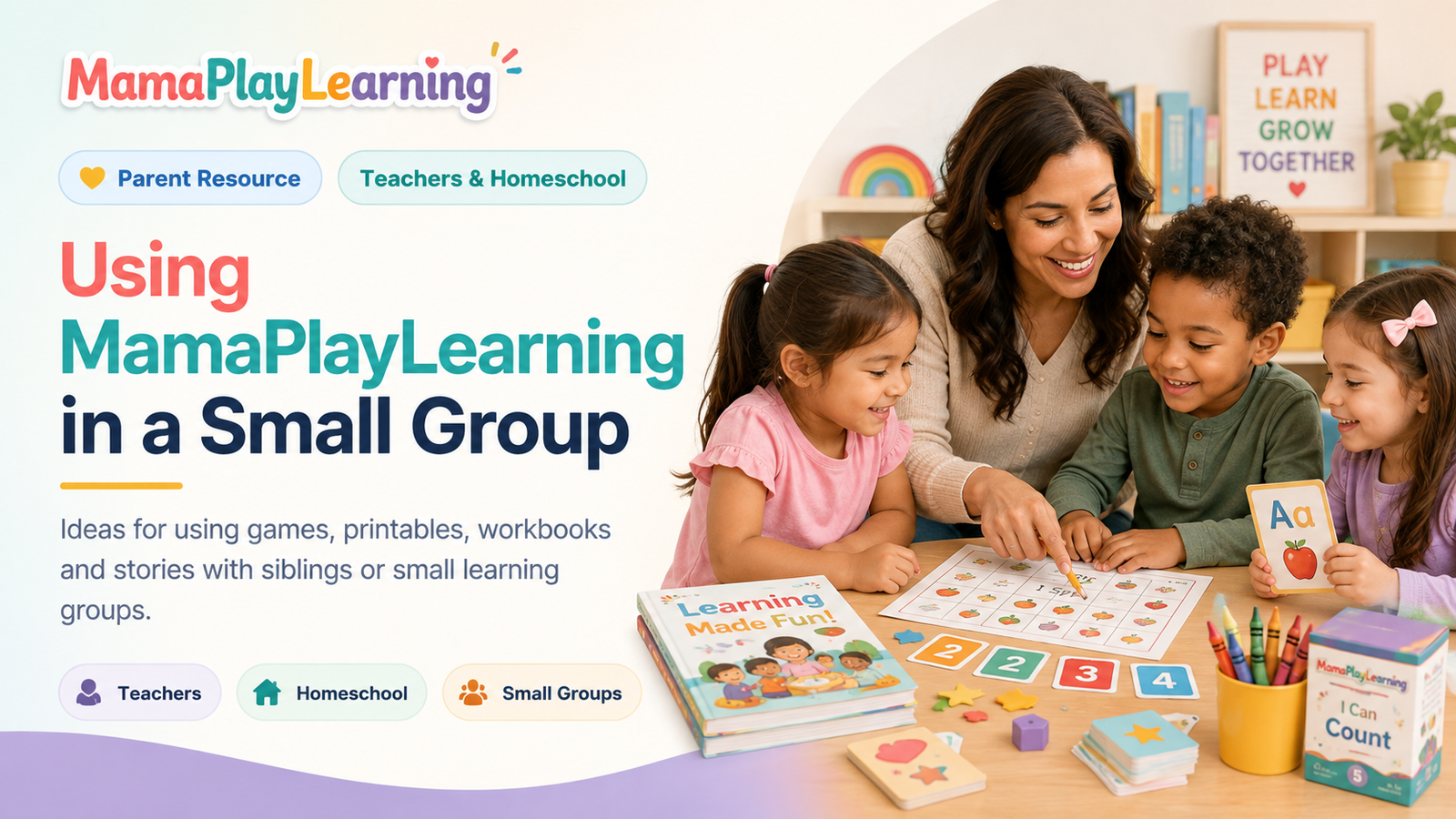
Using MamaPlayLearning in a Small Group
Ideas for using games, printables, workbooks and stories with siblings or small learning groups.
MamaPlayLearning resources are designed to be flexible. While many games, printables, workbooks and storybooks work beautifully one-on-one, they can also be adapted for siblings, co-ops, homeschool groups, small classrooms and other shared learning spaces.
That flexibility matters because small groups often include children with different personalities, interests, energy levels and abilities. One child may want to answer every question right away, another may watch quietly before joining in, and a third may need movement between activities.
The goal in a small group is not to make every child do the exact same thing in the exact same way. The goal is to create a shared learning experience that still leaves room for individual participation.
Why Small-Group Learning Can Work So Well
Small groups create opportunities that are a little different from one-on-one learning.
Children can learn through:
- Watching peers participate
- Listening to other children’s ideas
- Taking turns
- Practicing patience
- Helping one another
- Building confidence in a shared setting
For some children, a small group also adds excitement and motivation. A game feels more lively, a story discussion becomes more interactive and a simple activity may feel more fun when it is shared.
Start With a Simple Plan
You do not need a complicated lesson plan to use MamaPlayLearning materials with more than one child.
Before you begin, decide:
- What skill or theme you want to support
- Which resource you want to use first
- How long the group activity should last
- Whether the children will all do the same thing or rotate
- What kind of support or movement break may be needed
Clear structure helps the group feel calm and manageable.
Choose the Right Group Size
A “small group” can mean different things in different homes and learning settings.
It might be:
- Two siblings at the table
- Three children in a homeschool setting
- Four to six children in a co-op group
- A small center or rotation inside a larger class
In general, fewer children makes it easier to offer support, notice participation and keep transitions smooth. If you are just getting started, begin smaller and grow only if it still feels manageable.
Use Storybooks as a Shared Starting Point
Storybooks are one of the easiest resources to use with a group because they naturally bring everyone into the same experience.
You can:
- Read aloud to the whole group
- Pause to ask simple questions
- Invite children to predict what comes next
- Talk about the characters or feelings
- Connect the story to a later game or activity
Keep questions short
Instead of asking every child to respond to every page, choose a few moments where one or two children can answer while the others stay engaged by listening.
Use Games to Practice Turn-Taking and Participation
Games are often ideal for small groups because they already contain natural structure.
A MamaPlayLearning game can be used to:
- Practice letters, numbers or matching
- Build patience while waiting for a turn
- Encourage children to cheer for one another
- Create playful repetition without pressure
To keep group games smooth, explain the rules simply and model one turn before starting.
Adapt Printables for Group Use
Printables do not have to be limited to one child quietly working alone.
With a group, you can use printables in several ways:
- Project or display one page for everyone to discuss together
- Give each child their own copy
- Use one printable as a partner activity
- Turn printable pieces into a matching or sorting center
- Laminate or place pages in dry-erase sleeves for reuse
This can make a printable feel more active and flexible.
Let Workbooks Be a Quiet Follow-Up
Workbooks can be helpful in a small group when you want children to settle into a calmer, more independent task after a shared activity.
For example, you might:
- Read a story together.
- Play a short review game.
- Complete one workbook page connected to the theme.
This sequence helps the workbook feel like part of a larger learning flow instead of the entire lesson.
Use Different Resources for Different Purposes
Small-group learning often works best when resources are combined rather than used in isolation.
Storybook
Use to introduce a topic and bring everyone together.
Game
Use to practice a skill with turns, laughter and repetition.
Printable
Use for matching, sorting, discussion or partner work.
Workbook
Use for focused individual follow-up practice.
Mixing resource types helps meet different learning styles and energy levels within the same group.
Plan for Different Ages and Abilities
In many homeschool and sibling groups, children are not all at the same level.
You do not always need separate lessons for each child. Instead, you can adapt the same resource by adjusting the expectations.
For example:
- One child points to the letter, another names it, and a third gives a word that starts with it.
- One child counts five objects while another counts ten.
- One child colors or matches while another writes a response.
Same activity, different entry points
Children can stay together socially even when they are doing slightly different levels of the same task.
Use Rotation Stations If Needed
If you are working with several children, simple rotation stations can help keep the group moving.
A rotation might include:
- A reading station
- A game station
- A printable or workbook station
- A hands-on activity station
Stations do not need to be elaborate. Even two small rotations can make the group feel more organized and prevent long waits.
Keep Group Expectations Warm and Clear
Small groups go more smoothly when children know what respectful participation looks like.
Set a few simple expectations such as:
- Take turns
- Use kind words
- Keep hands on your own materials unless invited
- Listen when someone else is speaking
- Ask for help calmly
Short reminders are usually more effective than long lectures.
Build in Movement and Breaks
Children in small groups still need movement. Sitting too long can make the group less focused and more frustrated.
After a story or workbook page, you might:
- Stand and stretch
- Sing a quick song
- Do an action rhyme
- Walk to a different station
- Take a short outside break
Movement helps reset attention and keeps the group from feeling too heavy.
Notice Participation, Not Just Performance
In a group, it can be easy to focus on who answered correctly first or who finished fastest. Try to notice participation in broader ways.
You might acknowledge:
- A child who waited patiently
- A child who helped a sibling kindly
- A shy child who joined in
- A child who kept trying during a challenge
This helps protect confidence and makes the group feel more supportive.
Helpful Supplies for Small Groups
You can run a very successful small group with simple materials. The optional tools below may make setup and rotation easier.
Optional Small-Group Tools
Dry-Erase Sleeves
Helpful for reusing printables and workbook pages in a group setting.
View Dry-Erase SleevesVisual Timer
A timer can help children understand how long a turn or station lasts.
View Visual TimersManipulatives or Counters
Small hands-on pieces make group math, sorting and pattern activities easier to share.
View ManipulativesA Reminder for Parents, Teachers and Homeschool Families
Small-group learning does not need to look perfect to be meaningful. Children do not need elaborate lessons, fancy stations or long instruction blocks to learn well together.
Often the most successful group experiences are simple: one story, one game, one activity and warm guidance from an adult who understands the children in front of them.
If the group is connected, engaged and given room to participate in age-appropriate ways, that is already valuable learning.
MamaPlayLearning Takeaway
MamaPlayLearning resources can work beautifully in small groups when you keep the structure simple and the expectations flexible.
Use stories to gather the group, games to practice together, printables to extend the learning and workbooks for focused follow-up. Let children participate at their level, build in movement and keep connection at the center.
Bring playful learning into your small group
Explore MamaPlayLearning games, storybooks and free worksheets to support siblings, homeschool groups and small learning circles.