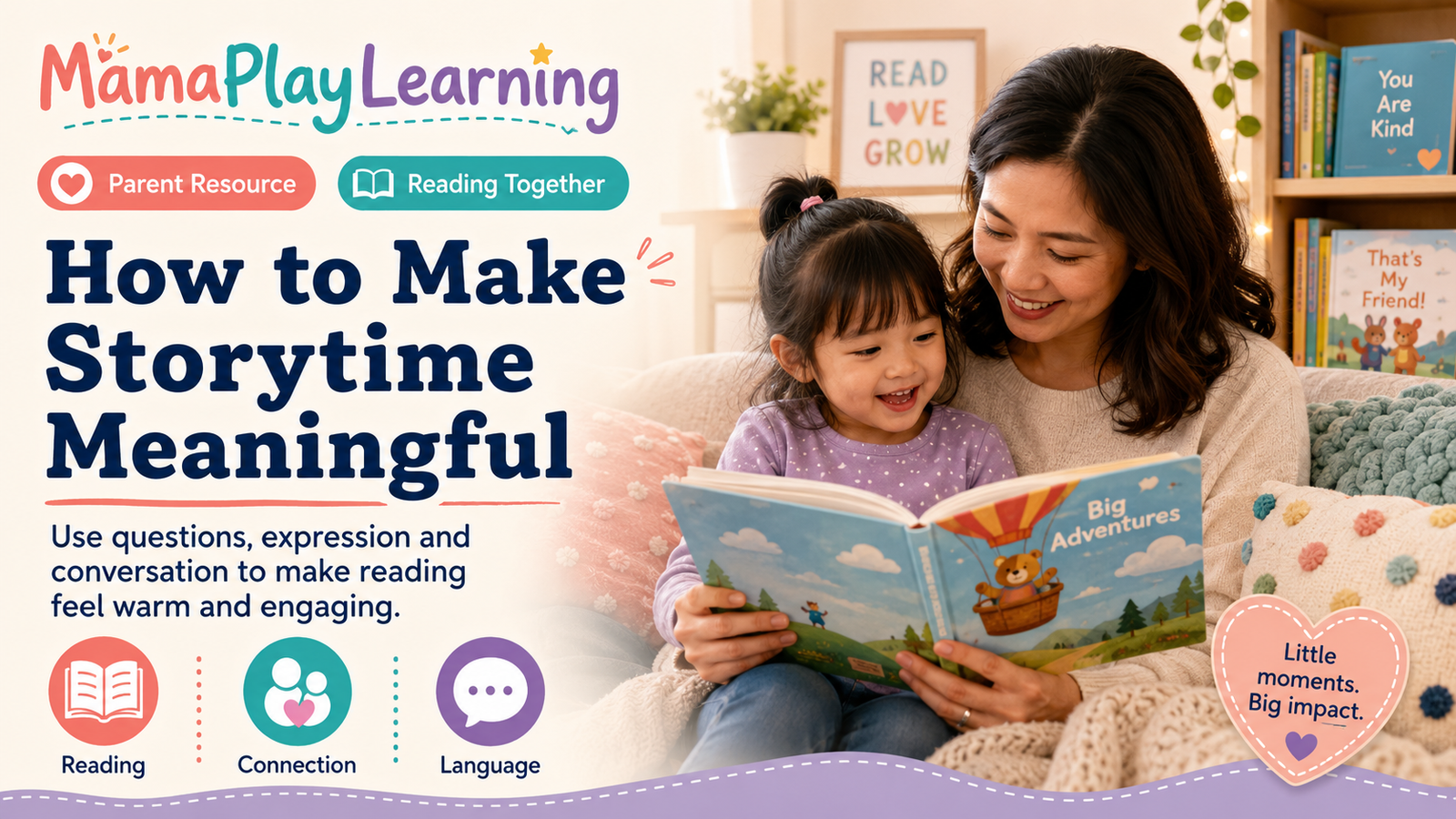
How to Make Storytime Meaningful
Use questions, expression and conversation to make reading feel warm, engaging and connected.
Storytime can be one of the warmest and most meaningful parts of a child’s day.
Reading together is not only about finishing a book or teaching a child to recognize words. It is also about connection, conversation, imagination and helping a child feel safe enough to wonder out loud.
A meaningful storytime does not require a perfect reading voice, a quiet room or a child who sits completely still. It simply requires a book, a little patience and a willingness to share the moment.
The goal is not to perform the story perfectly. The goal is to experience it together.
Let Your Child Help Choose the Book
Children are often more interested in reading when they have some choice.
You might offer two or three books and ask:
Giving a limited choice keeps the routine manageable while allowing your child to feel involved.
It is also okay when a child chooses the same book repeatedly. Repetition helps young children remember language, predict what comes next and notice new details.
Look at the Cover Before You Begin
Before opening the book, pause for a few seconds and look at the cover together.
You can ask:
- “What do you notice?”
- “Who do you think this story is about?”
- “Where do you think they are going?”
- “What do you think might happen?”
There does not need to be one correct answer. The purpose is to encourage observation and prediction.
Keep it simple
You do not have to ask questions before every book. Even one short comment such as “I wonder where that little bear is going” can invite curiosity.
Use Expression Without Feeling Like You Have to Perform
Children often enjoy changes in voice, volume, facial expression and pacing.
You can make the story more engaging by:
- Using a quiet voice during a sleepy scene
- Speaking faster during an exciting part
- Pausing before a surprise
- Making a silly voice for one character
- Changing your expression to match the character’s feelings
You do not need a different voice for every character. Small changes are enough.
A pause after a line like this gives your child time to react and wonder what comes next.
Ask Questions That Invite Conversation
Questions can support language and comprehension, but too many questions can make storytime feel like a test.
Use questions occasionally and choose ones that allow more than one possible answer.
Observation Questions
“What do you see on this page?”
Prediction Questions
“What do you think will happen next?”
Feeling Questions
“How do you think the character feels?”
Connection Questions
“Has something like this ever happened to you?”
It is okay if your child gives a very short answer, changes the subject or does not answer at all. You can simply continue reading.
Pause to Notice the Pictures
Illustrations give children information that may not be written in the text.
Pause when your child points, laughs or studies a page. That moment of attention is part of the reading experience.
You might say:
- “I see the puppy hiding under the chair.”
- “The sky looks darker on this page.”
- “That character has a surprised face.”
- “There are three birds in the tree.”
Describing the pictures introduces language without asking your child to prove what they know.
Let Children Move While You Read
Not every child listens best while sitting still.
A young child may:
- Stand beside you
- Hold a toy
- Rock gently
- Act out part of the story
- Turn pages back and forth
- Look away and then return
Movement does not always mean a child is not listening. Focus on whether your child is connected to the experience rather than whether they remain perfectly still.
Invite Participation
Children often enjoy joining in when a book has repeated words, sounds or actions.
You can pause before a familiar phrase and let your child finish it.
You can also invite your child to:
- Make an animal sound
- Copy a character’s movement
- Point to something in the picture
- Repeat a funny word
- Count a small group of objects
- Help turn the page
Participation helps children feel like part of the story instead of only a listener.
Connect the Story to Everyday Life
Books become more meaningful when children can connect them to familiar experiences.
You might say:
- “That character is wearing rain boots like yours.”
- “We saw a big truck like that yesterday.”
- “The child in the story feels nervous about trying something new.”
- “This family is making soup just like we did.”
These connections help children understand that stories can reflect real feelings, routines and experiences.
Talk About Feelings Gently
Stories give children a safe way to explore emotions.
If a character is angry, worried, excited or disappointed, you can name the feeling without turning the moment into a lecture.
This gives children language for feelings and introduces the idea that emotions can change as the story continues.
Do Not Worry About Finishing Every Book
Sometimes a child loses interest before the last page. That is okay.
You can:
- Stop and return later
- Skip a few pages
- Talk only about the pictures
- Choose a shorter book next time
- Let your child retell the story in their own way
Finishing the book is less important than keeping reading warm and positive.
Make Storytime Part of a Comfortable Routine
Reading can happen at bedtime, but it does not have to.
Other good times may include:
- After breakfast
- Before a nap
- During a quiet afternoon break
- While waiting for an appointment
- After coming home from childcare or school
- During a calm moment on the weekend
A consistent routine can help children know what to expect, but flexibility matters too.
Create a simple reading basket
Keep a few books in an easy-to-reach basket near the couch, bed or play area. Children are more likely to choose books when they can see and reach them.
When Your Child Wants the Same Book Again
Repeated reading may feel tiring to adults, but it serves an important purpose.
Each reading gives a child another chance to:
- Remember the sequence
- Join repeated phrases
- Notice new details
- Understand unfamiliar words
- Build confidence through familiarity
You can keep repeated reading fresh by changing one small thing. Ask a new question, notice a different picture or let your child tell part of the story.
Helpful Storytime Materials
You only need a book and a comfortable place to read. The products below are optional ideas for families who want to create a cozy reading routine.
Optional Reading Tools
Age-Appropriate Picture Books
Choose books with clear illustrations, engaging language and topics your child enjoys.
Browse Picture BooksFront-Facing Book Display
A low display can help children see book covers and choose independently.
View Book DisplaysCozy Reading Pillow
A comfortable floor pillow or cushion can create a welcoming reading spot.
View Reading PillowsBook Storage Basket
A simple basket keeps favorite books visible, organized and easy to reach.
View Book BasketsA Reminder for Parents and Caregivers
You do not need to make every page educational.
You do not have to ask a question after every sentence, explain every unfamiliar word or correct every detail your child says.
Sometimes the most meaningful part of storytime is simply sitting close, laughing together and sharing a book your child loves.
Reading supports language and learning, but it also communicates something deeper:
MamaPlayLearning Takeaway
Meaningful storytime is built through warmth, attention and conversation—not perfection.
Let your child choose, pause for pictures, use expression, invite participation and follow their interest. A few connected minutes with a book can support language, imagination, confidence and your relationship.
Keep reading and learning together
Explore MamaPlayLearning storybooks, games and free worksheets designed to make early learning joyful and connected.