
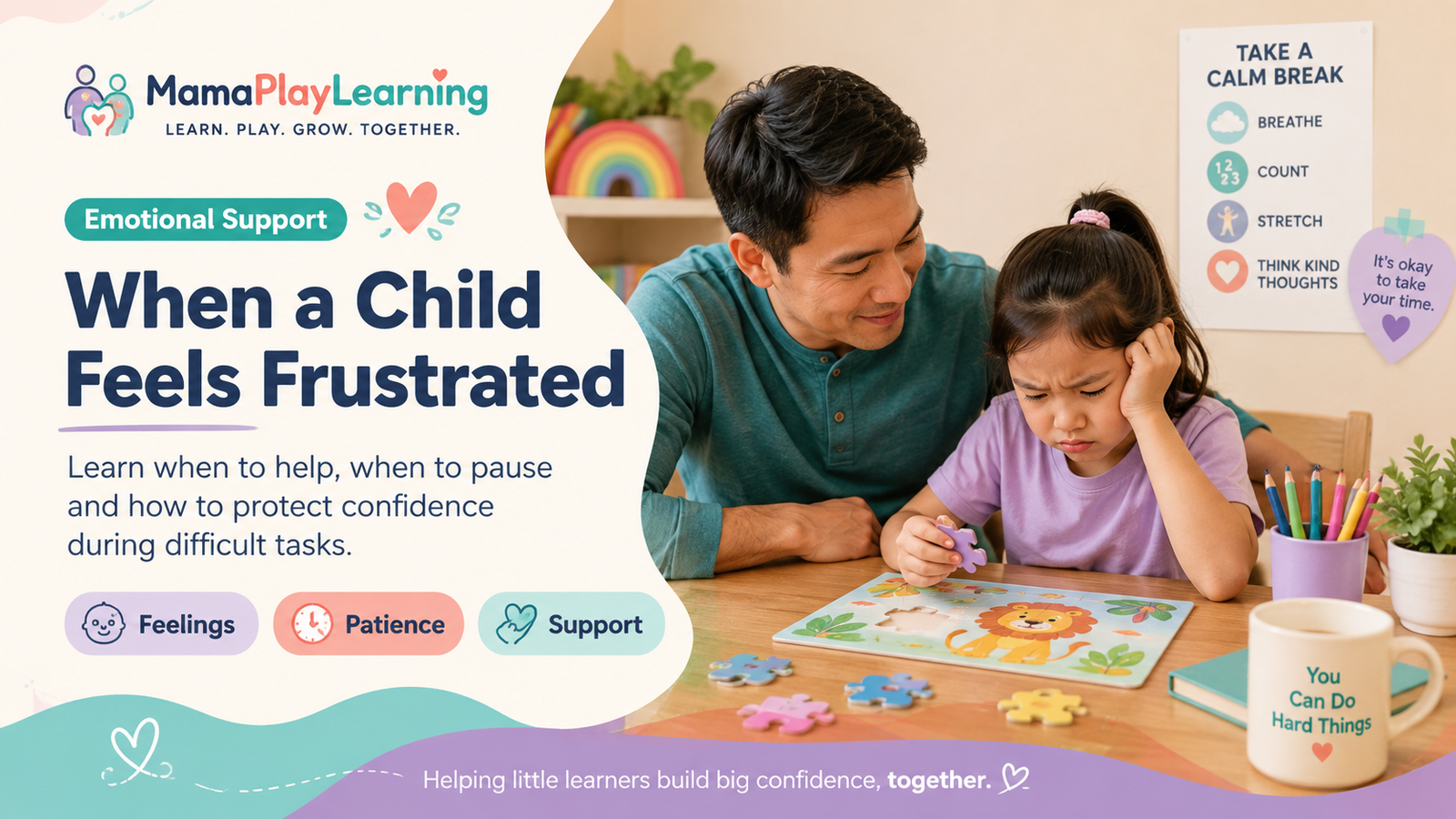
When a Child Feels Frustrated
Learn when to help, when to pause and how to protect confidence during difficult tasks.
Frustration is a normal part of learning. It often appears when a child wants to do something, but the skill, attention, patience or coordination needed to do it is still developing.
A puzzle piece will not fit. A tower falls down. A letter looks different than expected. A game feels hard. A child wants to succeed right away, but the task is asking more than they are ready to give in that moment.
For adults, it can be tempting to step in quickly, fix the problem or urge the child to keep going. But the way we respond during frustration can either protect confidence or make a child feel smaller and more overwhelmed.
The goal is not to remove every hard feeling. The goal is to help children feel supported while they learn how to handle hard moments.
Why Frustration Happens
Children may feel frustrated for many reasons, including:
- The task is slightly above their current skill level
- They are tired, hungry or overstimulated
- They expected success to happen quickly
- They are comparing themselves to someone else
- They do not know what to do next
- They feel embarrassed about making a mistake
Sometimes the learning activity is not too hard in general—it is simply too hard for that moment. A child who could do the task earlier may struggle later if they are already worn out.
First, Notice the Feeling Before Fixing the Task
When a child is upset, adults often move quickly into solutions. But before offering help, it can be powerful to simply notice what is happening.
Naming the feeling helps the child feel seen. It tells them that their emotional experience matters, not just their performance.
You might also say:
- “You were trying hard, and it didn’t work the way you wanted.”
- “I can see this is bothering you.”
- “That was disappointing.”
This kind of response calms more effectively than immediately jumping into correction or criticism.
Pause Before You Help
Not every moment of frustration requires immediate adult rescue.
Some frustration is productive. It gives children a chance to think, try another strategy and build resilience. If the child is still regulated enough to continue, a short pause may be more helpful than stepping in too quickly.
Watch before acting
If your child is still focused, still trying and not overwhelmed, you may only need to stay close and give them a little time.
This pause communicates trust. It says, “I believe you may be able to work through part of this.”
Know When Help Is Actually Needed
Sometimes a child does need support. The key is to give enough help to move them forward without taking over the whole task.
You might:
- Offer one small hint
- Point to the next step
- Hold a piece steady while they continue
- Break the task into smaller parts
- Ask a guiding question
This keeps the child involved instead of turning the moment into the adult doing the entire activity.
Use Calm, Low-Pressure Language
When frustration rises, children often need fewer words, not more. Long explanations can feel overwhelming when emotions are already high.
Helpful language is calm, simple and steady.
Helpful phrase
“You are safe. We can slow down.”
Helpful phrase
“Let’s look at one small part first.”
Helpful phrase
“You don’t have to do it all at once.”
Helpful phrase
“It’s okay to take a break and come back.”
This kind of language protects confidence far better than “It’s easy,” “You know this,” or “Stop getting upset.”
What Not to Say
Some common adult responses can unintentionally make frustration worse.
Try to avoid phrases such as:
- “This is easy.”
- “You’re fine.”
- “Stop crying.”
- “Your brother can do it.”
- “You’re being dramatic.”
Even if these comments are meant to push a child forward, they can create shame or make the child feel misunderstood. A child who feels judged is less likely to stay emotionally open and more likely to shut down or escalate.
Break the Task Into Smaller Steps
Many frustrations come from the child seeing the whole problem at once instead of one manageable step.
You can make the task feel safer by shrinking it.
For example:
- Instead of “finish the whole worksheet,” say “let’s do the first line.”
- Instead of “build the whole tower,” say “let’s find a stronger bottom.”
- Instead of “write the whole word,” say “let’s start with the first sound.”
Small steps make success feel possible again.
Remember That Breaks Are Not Failure
Adults sometimes worry that if a child steps away from a difficult activity, they are giving up. But breaks can be a healthy strategy.
A short pause can help a child reset physically and emotionally. It may include:
- Taking deep breaths
- Standing up and stretching
- Getting a drink of water
- Moving to a quieter area
- Doing a different calming activity for a few minutes
The purpose of the break is not to avoid all difficulty forever. It is to reduce overwhelm so the child has a better chance of returning with more regulation.
Protect Confidence While Still Teaching Persistence
Supporting a frustrated child does not mean removing all challenge. Children still need to learn that hard things can become easier with practice.
The difference is in how that message is delivered.
This kind of response communicates both truth and hope. It does not deny the difficulty, but it also does not define the child by the struggle.
After the Hard Moment, Reflect Briefly
Once the child is calm again, you can revisit what happened in a very simple way.
You might ask:
- “What part felt hard?”
- “What helped you calm down?”
- “Should we try a smaller step next time?”
- “Would you like help sooner or a longer pause next time?”
This helps children begin learning how to recognize their own patterns and needs.
Frustration Looks Different in Different Children
Some children cry. Some become angry. Some shut down quietly. Some ask for help right away, while others refuse help even when they need it.
Because frustration can look different from child to child, it helps to observe patterns over time. Ask yourself:
- When does my child usually get frustrated?
- What kinds of tasks trigger it most?
- What helps them recover?
- When do they need space, and when do they need closeness?
Knowing your child’s patterns can help you respond more calmly and effectively next time.
Stay nearby when possible
Children often regulate more easily when a calm adult remains close, even if that adult is not talking much.
Helpful Supplies for Hard Moments
You do not need special products to support a child emotionally, but a few simple tools can make it easier to create calm and offer gentle structure.
Optional Emotional Support Tools
Feelings Picture Books
Stories about emotions can help children recognize and talk about frustration in a safe, age-appropriate way.
View Feelings BooksCalm-Down Cards
Simple visual prompts can remind children of calming choices such as breathing, stretching or taking a short break.
View Calm-Down CardsFidget or Sensory Tools
A few quiet sensory tools may help some children reset before returning to a difficult task.
View Sensory ToolsBeginner Puzzles or Fine-Motor Activities
Age-appropriate activities can provide safe practice in working through small challenges without too much frustration.
View Practice ActivitiesA Reminder for Parents and Caregivers
When children feel frustrated, they do not only need instruction. They need co-regulation, patience and a sense that their worth is not reduced by a hard moment.
You do not have to fix every problem instantly. Often the most helpful thing you can do is stay calm, notice the feeling, offer just enough support and help the child believe that difficult moments are survivable.
That kind of response teaches far more than the task itself. It teaches children that they can struggle, pause, recover and keep going.
MamaPlayLearning Takeaway
Frustration is part of learning, but shame does not have to be.
Notice the feeling first, pause before taking over, offer small and calm support, and let breaks be a healthy tool when needed. When adults protect confidence during hard moments, children are more able to keep trying.
Support learning with patience and connection
Explore MamaPlayLearning games, storybooks and free worksheets created to build confidence, calm and joyful early learning.