Praise Effort, Not Perfection
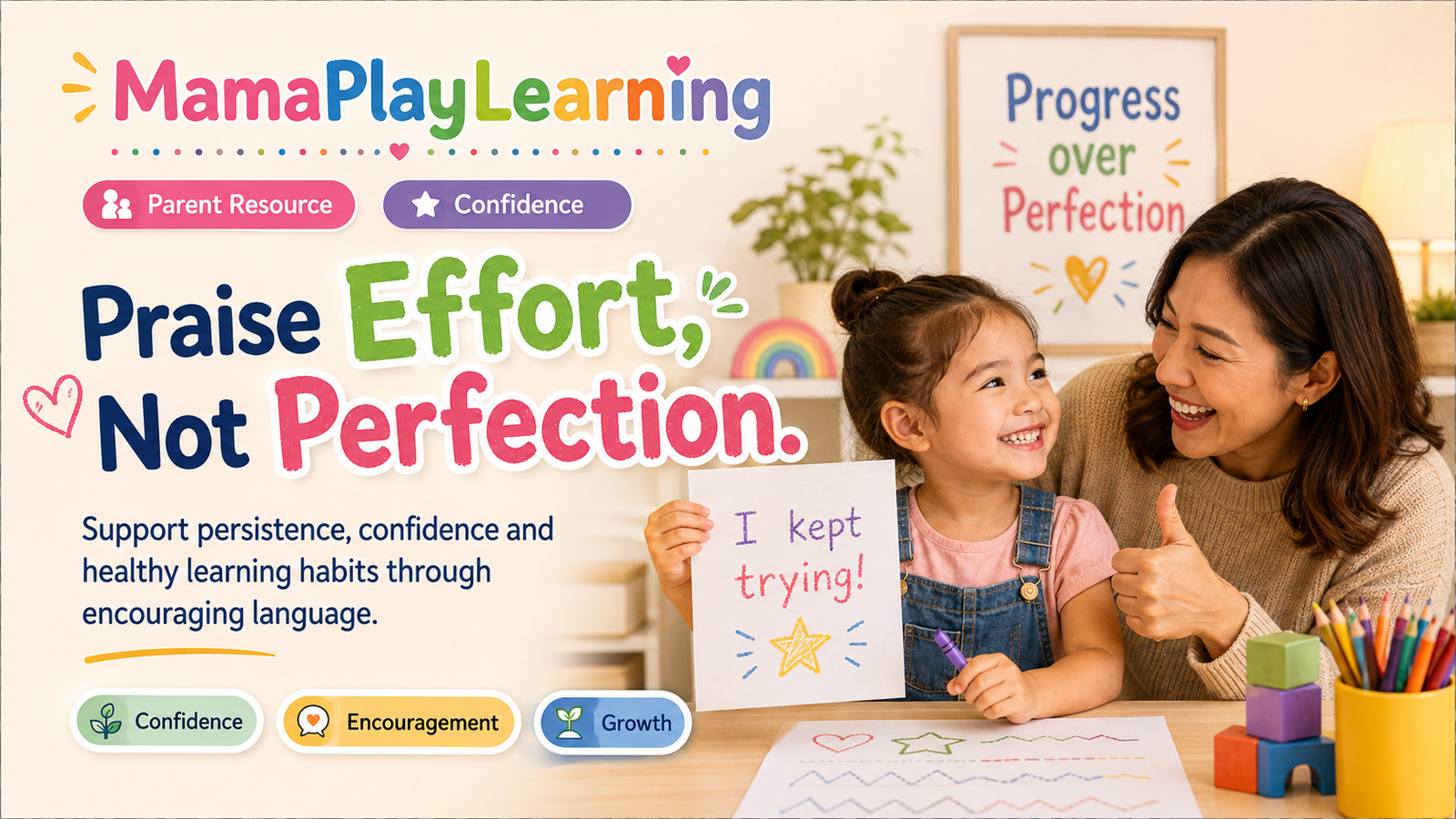
Support persistence, confidence and healthy learning habits through encouraging language.
Most parents and caregivers want children to feel proud of themselves. We cheer when they finish a puzzle, write a letter correctly, build a tower or finally zip their own jacket.
But the way we praise children matters. If children begin to believe that being “good” only means being perfect, getting the right answer immediately or never making mistakes, learning can start to feel stressful.
Children grow best when they understand that learning is a process. Trying, practicing, adjusting and starting again are all part of how skills develop.
Praising effort instead of perfection helps children build persistence, confidence and a healthier relationship with mistakes.
What Does “Praise Effort” Mean?
Praising effort means noticing the work, strategy, patience and persistence a child used—not only the final result.
That might sound like:
- “You kept trying even when that was tricky.”
- “I noticed you slowed down and looked carefully.”
- “You tried a different way when the first one didn’t work.”
- “You stayed with it longer this time.”
This kind of praise teaches children that their choices and persistence matter. It helps them see that success is not only about natural talent or getting everything right immediately.
Why Perfection Can Be a Problem
Children who feel pressure to be perfect may begin to avoid challenges. If they think mistakes mean they are not smart, not good enough or disappointing someone, they may give up faster or refuse to try something new.
Perfection pressure can sound like:
- “I can’t do it.”
- “I messed it up.”
- “It has to be right.”
- “I’m not good at this.”
When adults shift the focus away from perfect results and toward effort, progress and problem-solving, children often feel safer to keep learning.
Be Specific Instead of Saying Only “Good Job”
There is nothing wrong with saying “good job,” but on its own it does not tell a child what you actually noticed.
Specific praise is more useful because it helps children understand what they did that worked well.
Instead of
“Good job.”
Try
“You matched all the shapes carefully and kept checking your work.”
Instead of
“You’re so smart.”
Try
“You worked hard on that and kept trying different ideas.”
Specific praise tells children what behaviors and strategies are worth repeating.
Praise the Process, Not Just the Outcome
There are many parts of learning worth noticing even when the activity is not finished or the answer is not correct yet.
You can praise things such as:
- Trying again after a mistake
- Staying calm through a challenge
- Asking for help appropriately
- Using a new strategy
- Working carefully
- Focusing for longer than before
For example, if a child builds a tower that keeps falling, you could say:
This helps the child focus on the thinking behind the work, not only on whether the tower stayed up in the end.
Let Mistakes Be Part of Learning
Children need to know that mistakes are not proof of failure. Mistakes are information. They show us what still needs practice.
When a child makes an error, you do not need to rush into disappointment or immediate correction. Instead, you can treat the moment as part of the learning process.
You might say:
- “That one was tricky.”
- “Let’s look at it together.”
- “You’re still learning this.”
- “What could you try next?”
Normalize trying again
Children often feel calmer when adults respond to mistakes as something ordinary instead of something shameful.
Avoid Labels That Tie Worth to Performance
Telling a child “You’re the smartest” or “You’re perfect” may sound positive, but it can unintentionally make performance feel like identity.
If children begin to think they must always live up to that label, they may fear situations where they are unsure or still learning.
Instead of attaching praise to identity, attach it to effort, habits and progress.
This tells children that growth comes from what they do, not from a fixed label they have to protect.
Notice Progress Over Time
One of the most encouraging things you can do is help a child see their own growth.
You might point out:
- “Last week you needed more help. Today you did the first part by yourself.”
- “You stayed with the puzzle much longer this time.”
- “Your hand control is getting stronger.”
- “You are remembering more letters than before.”
This kind of praise builds confidence because it shows children that their effort is leading somewhere.
Use Encouraging Language During Frustration
Children do not only need encouragement after they succeed. They need it while they are struggling.
When a child is frustrated, helpful praise may sound quieter and calmer.
Helpful phrase
“I can see you are working hard on this.”
Helpful phrase
“You do not have to finish it all at once.”
Helpful phrase
“Let’s take a breath and try one small step.”
Helpful phrase
“You’re learning. It’s okay for this to be hard.”
Encouragement during hard moments protects confidence better than praise that only appears at the finish line.
Do Not Overpraise Everything
Praise is most useful when it feels real and connected to what the child actually did.
If every single action receives exaggerated praise, children may stop hearing what is meaningful about it. They may also begin looking outward constantly for approval instead of noticing their own effort.
Sometimes a simple observation works better than big praise.
That kind of calm noticing helps children reflect on their own work without needing everything to become a performance.
Model a Healthy Response to Your Own Mistakes
Children learn from how adults speak to themselves.
If you spill something, forget a step or do something imperfectly, let your child hear a calm response instead of harsh self-criticism.
You might say:
- “Oops, I made a mistake. I can fix it.”
- “That didn’t work the first time. I’ll try another way.”
- “I’m still learning how to do this too.”
This models the exact mindset you want your child to develop.
Confidence Grows Through Safety and Practice
Confidence is not built by constant praise alone. It grows when children feel safe enough to try, supported enough to continue and calm enough to recover from mistakes.
That is why praise works best when it is combined with:
- Realistic expectations
- Age-appropriate challenges
- Time to practice
- Permission to make mistakes
- Warm connection with an adult
Encouraging language is powerful, but it works best inside a relationship where children feel accepted even when they are still learning.
Helpful Supplies for Encouraging Growth
You do not need special products to support a child’s confidence. Still, a few simple tools can help create playful, low-pressure practice opportunities.
Optional Confidence-Building Tools
Growth Mindset Picture Books
Stories about persistence, mistakes and trying again can support healthy self-talk.
View Picture BooksSimple Puzzle Sets
Manageable puzzles give children safe opportunities to practice perseverance and problem-solving.
View PuzzlesOpen-Ended Art Supplies
Art materials encourage process-focused creativity where there is no single “perfect” result.
View Art SuppliesReusable Dry-Erase Practice Boards
These can make it feel easier to practice, erase and try again without pressure.
View Practice BoardsA Reminder for Parents and Caregivers
Children do not need to hear that they are perfect. They need to know they are loved, supported and capable of growing.
When you notice effort, strategy, patience and improvement, you help children build confidence that is steadier than praise based only on results.
They begin to understand that hard things can become easier, mistakes are survivable and trying again is something to be proud of.
MamaPlayLearning Takeaway
Confidence grows when children learn that effort matters more than perfection.
Notice the process, name the progress, stay calm around mistakes and use encouraging language that helps children feel safe to keep learning. The goal is not flawless performance—it is steady growth.
Keep building confidence through playful learning
Explore MamaPlayLearning games, storybooks and free worksheets created to support growth, encouragement and joyful early learning.